
The Eye of Photography | Soo Burnell by Carole Schmitz
The Questionnaire
Your first photographic trigger?
I got my first camera when I was 13, and my early photos were portraits of my friends. I was drawn to portraiture. While my work now focuses on architecture, on spaces, there are always figures within those spaces, grounding each scene. My work has evolved very far from those origins in my teenage years, as you’d expect, but I’m still drawn to the presence of those figures and to their untold stories.
A photographic memory from your childhood?
Holiday photographs. Maybe that’s the same for most people? I look back on those old family photos taken on holidays over the years, and they remind me of the summers of my childhood.
The camera of your childhood?
My Dad gave me an Olympus OM-10. I traded it in to get a better camera when I started studying photography. I really wish that I still had it.
The one you use today?
The Fuji GFX 100 – a medium format camera that I love.
The man or woman of the image who inspired you?
I am inspired a lot by film and cinematography. I find the meticulous work of Wes Anderson absolutely mesmerising; I love the way he uses colour. I also love the work of Canadian painter Alex Colville.
The image you wish you had taken?
There are so many... Where do I begin? I love the work of the architectural photographer Julius Shulman. His book, A Constructed View, is beautiful, and I saw an incredible documentary about him called Visual Acoustics. Imagine having the opportunity to photograph these iconic pieces of architecture, and to have experienced those buildings at or around the time they were built.
Slim Aarons’ Poolside Gossip is an iconic image, as is William Klein’s Gun, New York, 1955, and Butlins by the Sea by Martin Parr. Also, not to forget work by many of my photographer friends like the incredible work of Jeff Czum.
The one that moved you the most?
Still images are so powerful. Napalm Girl by Huỳnh Công Út (Nick Ut) is an image that stays with you forever - for all the wrong reasons.
And the one that made you angry?
I struggle with any image where someone has taken out their camera instead of helping a person. I am not talking so much about war photography as there is clearly a very defined and important purpose behind it, but more that people seem to be very quick to capture things on their phones instead of offering help.
Also, anything AI. I see amazing images and wonder where those incredible places are… then feel duped!
Which photograph changed the world?
There are photos that we all know that are recognised as having ‘changed the world’ – we probably all have images in our mind with that question. I couldn’t pick one. We take a lot for granted now that we can browse everything and anything on our phones, and you could argue that photography doesn’t have the same power now when we have easy access to so much. Maybe one photo doesn’t change the world now, but a photo can still change our perspective on something, or give us an understanding that we might not have had otherwise – and I think that’s incredibly powerful, even on an individual level.
And which photograph changed your world?
This question is so hard… There are so many, it’s impossible to select just one - from important historical war photography like Tank Man by Stuart Franklin to whimsical work by Tim Walker. There’s an image of his of Lily Cole with beautiful blue drapes of material hanging off a spiral staircase. He has incredible ideas. I’d love to be in his head.
A key image in your personal pantheon?
There are so many… The way the light hits the water in Iceland; the silent echoes from the old Victorian baths in Edinburgh; the colours of India and the smiles and laughter from my models when we were on location there; the geometry of the architecture in Japan and the sense of stillness I experienced in those spaces.
What interests you most in an image?
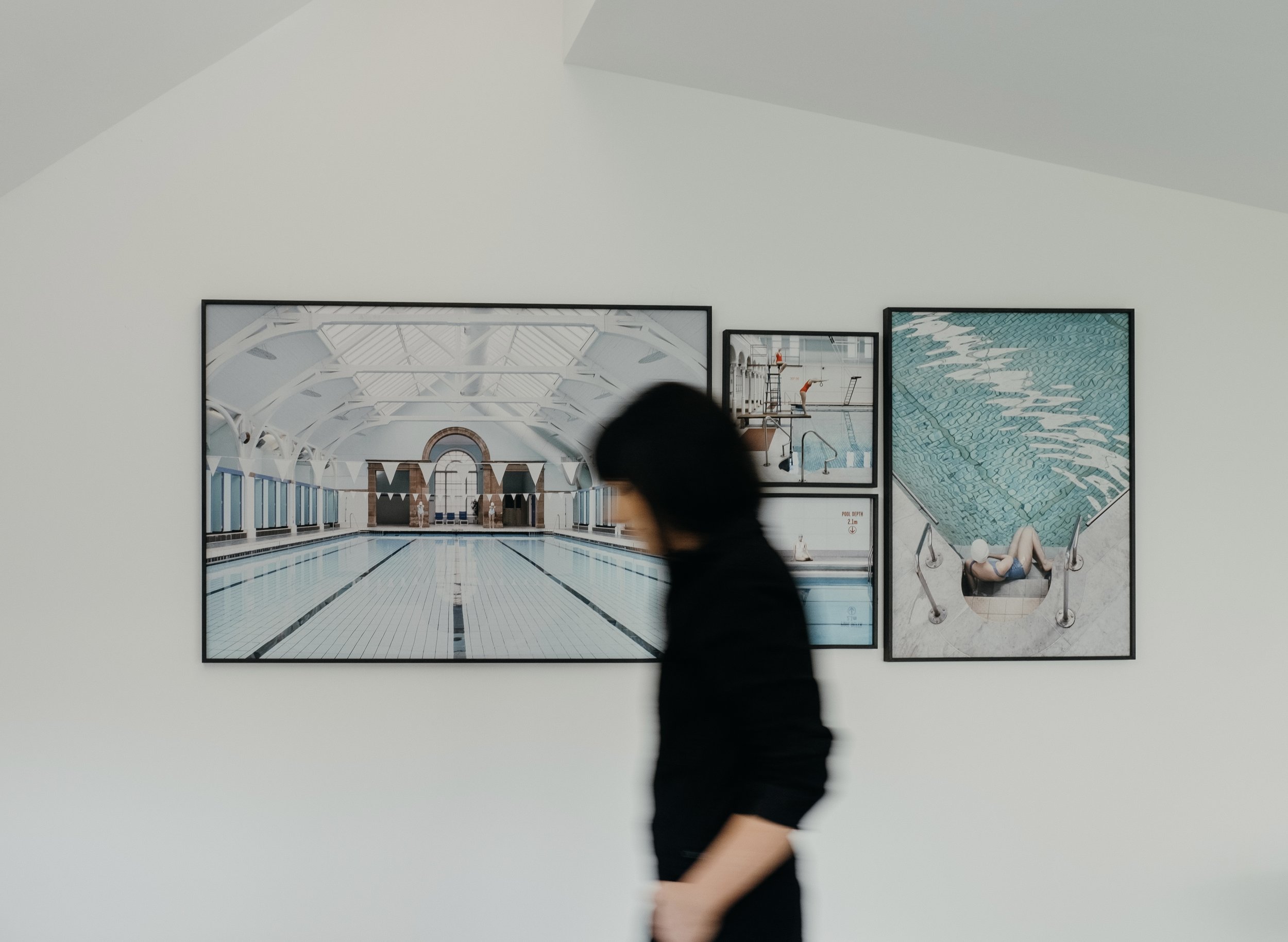
In my own photography, I’m always drawn in by the architecture. Growing up in Edinburgh, I was always inspired by the iconic buildings and architecture that Scotland’s capital city is renowned for, and this went on to really influence my work. This love of architecture led to my poolside series.
My work explores this passion for architecture and for composition, as I’m drawn to the geometry and the natural light, and in how this creates the atmosphere within each space. I’m also fascinated by the relationship that people have to those buildings and those spaces. It isn’t only about the structures; it’s about the way we interact with those spaces.
With other people’s photography, again, I’m drawn to the people – what they’re doing, who they might be, what their story might be.
What details do you look for in a face, a landscape, or an object?
I like hidden portraits. I enjoy that ambiguity where the viewer is left wondering who the subject is and what their story might be. I enjoy creating those stories and hope that each piece can have a different story for each viewer.
Elliott Erwitt said: “Color is descriptive. Black and white is interpretative.” Do you agree?
Yes, I do. The use of colour is always integral to my work. I plan a detailed colour palette for each location, in terms of the clothing and any props being used by the models, and the colours are chosen to work within that specific context. I also use blocks of colour to show interesting shapes and proportions in a space. The use of colour is a core part of the story for me.
In your opinion, can technique sometimes take precedence over emotion in photography?
I am sure it can for some people’s work. That can be a conscious choice for some photographers. I don’t feel that’s true of mine though. I want people to feel something when they look at a photograph, whether that’s a sense of calm, which is definitely an intention for me in a lot of my work, or whether there’s a feeling of intrigue around the characters in a photo.
Towards the end of last year I started work on a new collection that was shot on location in London. It’s a deeply personal collection for me as it evolved through my experience of grief after losing a very close friend, and while technical, as this was shot entirely underwater, the images feel quite haunting and otherworldly. I haven’t released the collection yet, but people who have seen it talk about the emotional impact of the photos. Again, it comes back to the intention behind the work.
Is beauty in photography, for you, purely aesthetic?
No, not at all. Again, coming back to the last question, it’s about how a photograph makes you feel. There can be beauty in that emotional response and connection that goes far beyond the aesthetic.
What elements can make silence visible in a photograph?
This is something I consider a lot in my work. I’m always drawn to stillness. In my poolside pieces, there’s the stillness of the water, and in the way the light shifts and changes in a space and the sense of calm this creates. There’s a sense of quietness in the figures, who are always still within the space. I always want to capture – create – these quiet, still moments, and using natural light is also key to this.
Also I think that removing distractions helps create this sense of quietness. When I look at a scene, I want to strip away anything extraneous; anything that distracts your eye and reminds you that you’re in a contemporary setting. I’m doing a lot more post-production on my images now than when I started, and I work with a very talented re-toucher and love this process of collaboration and sharing ideas.
For me, it’s about minimising the ‘modern’ distractions and taking a building or a space back to how it was intended. There’s a balance between what I choose to keep and what isn’t necessary for the image. At the same time, I like people to feel that this is how the buildings are and that they can step into them.
Does the uniqueness of a photograph come from the moment or from staging? Can a photograph be truer than reality?
I think this question comes back to my previous point about removing distractions. In the context of the swimming pools, as an example, that might be modern signage or safety instructions – the things that catch our attention, but they can detract from the overall experience of a space. So I don’t think it’s about being truer than reality, but it can be about removing some of the unnecessary visual ‘noise’ that we live with so that we can really see or feel a scene.
Can a photograph change our perception of an event?
Yes, absolutely. A photographer can hone in on a detail, whereas our eye will usually take in a wider sweep, a broader context with lots of information. But by focusing on a detail, an area within the wider frame, you can tell a clear story of what that moment is about.
However, only viewing an event through that honed in detail can also lose the wider context. So yes, it can change our perception, but that can be both a good and a bad thing, depending on that context.
Is photography a testimony or a form of manipulation?
Again, this depends on the aims. My work is very different in approach and intention to street photography, for example. It’s very different to portraiture. Photography can be both testimony and manipulation, depending on style, subject, approach, intention…
What makes a good photograph?
If it connects with you. When you look at a photograph, do you feel something? I think that lies at the root of what makes a ‘good’ photograph.
In your opinion, what quality is necessary to be a good photographer?
You need to be able to see the world in an interesting way. I think that’s true regardless of the specifics of your style or subject. It’s about seeing things and interpreting those things in a way that starts a dialogue with whoever is viewing your work.
How do you choose your projects?
I get fascinated by places first and start to research them. Then I build a storyboard of ideas.
How would you describe your creative process?
It takes a long time researching and connecting with places and people. I don’t share as much of it as I probably should. I sketch up storyboards, I make a lot of the props and costumes and cut any wigs I might be using, and I plan the colour palette for the series well in advance of taking any pictures. I love every part of the process.
An upcoming project that is particularly close to your heart?
I have a few great projects happening this year including a new series shot on location in Jaipur, and I’m working with the Royal Botanic Garden Edinburgh on a series for them. The underwater collection I mentioned earlier is also due for release this year and is my most personal collection to date.
The person you would like to photograph?
Tilda Swinton – an incredible talent, and a fascinating actor who seems to transform so fully in front of a camera.
The person by whom you would like to be photographed?
I am not keen on having my own picture taken but perhaps being part of a scene created by Slim Aarons would be fun.
An essential photography book?
I have hundreds! If I had to narrow it down to just two I’d say: New York 1954-1955 by William Klein is a prize possession, and United Kingdom by Martin Parr.
What is the last photograph you took?
I have just arrived home two days ago from photographing the new collection in Jaipur and that was an incredible experience – a very different colour palette, different light, and a different story. I’m excited to start working on those images.
On social media, are you more Instagram, Facebook, TikTok — and why?
Instagram has connected me with lots of great new friends. I’ve been on Instagram for years and it’s still my place to be.
What has changed in photography since the rise of social media?
Again, AI. I find it depressing, and I know I’m not alone in thinking this.
An Instagram account everyone should follow?
@samyoukilis is capturing life so beautifully. I could look at his account for hours.
What is your view on AI?
See the above answer!
Color or black and white?
Colour, always.
Natural light or artificial light?
Natural light. Nothing compares to it.
Which city seems the most photogenic to you?
At the moment, Jaipur! I spent 18 days there and left feeling so inspired by the light and colours and architecture, and most of all by the people I met. It was a very intense and beautiful trip. But I have also photographed many beautiful places.
The city, country, or culture you dream of discovering?
I have an extensive list of places I would love to visit… I’m working on this. South Korea has some very interesting architecture and the colours appeal to me a lot. I would also like to go back to Japan. I could stay a whole year there and still find fascinating places to photograph.
A place you never tire of?
The Royal Botanic Garden in Edinburgh – whenever I visit, I see something new. The gardens are constantly evolving over the seasons. I’ve known this place since I was a child and it’s always a lovely place to spend time in. And the Onsen baths in the mountains of Gumna in Japan, where I visited to photograph my At the Onsen collection. I would go back there tomorrow if I could.
The image that, for you, represents the current state of the world?
I’ve mentioned this one already - Tank Man by Stuart Franklin. I wish this wasn’t the image that came to mind at the moment, but it is.
In your opinion, what is missing in today’s world?
Good news and empathy.
If God existed, would you ask Him to pose for you, or would you opt for a selfie with Him?
Pose. I don’t like selfies, and I don’t like how people are increasingly experiencing places through taking selfies. So we’d work out a location, and I’d take His portrait.
Your favourite drug?
Coffee. Always coffee!
Your best way to disconnect?
Being near water. That might be a pool or a beach. It might be a loch in Scotland. I love the calmness water brings.
Your latest madness?
I am currently obsessed with everything India - the music, the art, the food, the chai, the smells, the history - I fully immersed myself for my latest collection and I can’t get enough!
Your greatest professional extravagance?
Equipment, travel, and staying in nice hotels.
A profession you would not have liked to pursue?
Politics or something Financial. Actually, I can’t imagine doing anything other than photography so the list is long!
Which question unsettles you the most?
There are many at the moment, to be honest, but ‘how will AI impact on our world?’ is right up there.
The last thing you did for the first time?
I nearly died in a tuk tuk last week! It was my first experience of being driven around Jaipur in a tuk tuk, and it felt wonderfully chaotic.
Your greatest regret?
I’d like to have studied in New York.
If you had to start all over again?
I’d love to. I’d do it all again!
If I could organize your ideal dinner, who would be at the table?
Tilda Swinton, Wes Anderson, Des Gwinnell, Bong Joon Ho and Sir David Attenborough. It would also be lovely to gather friends from all over the world together. What an incredible conversation that would be.
What do you like people to say about you… after you’re gone?
That she was kind.
The one thing people absolutely must know about you?
I love being away somewhere, on location, immersed in a shoot I’ve been planning and exploring a new city or country, but I'm at my happiest at home, in my studio, with my dogs Ruby and Nola beside me. Even when I’m busy working on something, it’s my tranquil space.
A final word?
I’ve really enjoyed these questions. Thank you for having me!